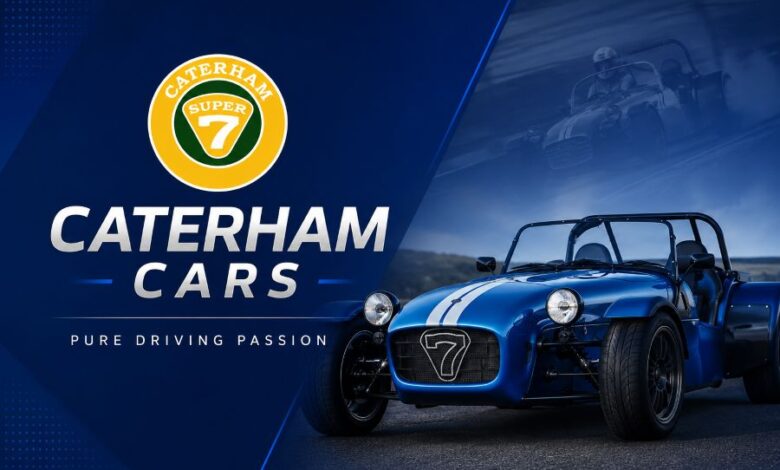
Caterham Cars: Owner, CEO, History, Models, Revenue and Project V
The British maker behind the Caterham Seven still builds cars by hand in Kent, but Japanese ownership, a bigger factory and an electric sports coupé are opening a new chapter.

Introduction
Caterham Cars is one of those companies that does not need huge production numbers to get attention.
Its best-known car is tiny. Very tiny.
The Caterham Seven can weigh from around 440 kg depending on the model and specification. It has exposed front wheels, two seats, hardly any excess bodywork and a shape with roots going back to the Lotus Seven.
But the company around that car has changed.
Caterham is now owned by Japan’s VT Holdings, builds its cars at a 54,000 sq ft factory in Dartford and has a stated production capacity of up to 750 cars a year. Its next big product may look nothing like a Seven: Project V, a rear-wheel-drive electric sports coupé that reached working-prototype testing in 2026.
So, what is Caterham Cars today?
Here is the full picture.
Quick Facts About Caterham Cars
| Fact | Details |
|---|---|
| Company name | Caterham Cars Ltd |
| Company number | 01171408 |
| Business | Lightweight sports-car manufacturing |
| Founder | Graham Nearn |
| Caterham Cars started | 1959 |
| Seven production rights acquired | 1973 |
| Present legal company incorporated | 23 May 1974 |
| Original registered name | Seven Cars Limited |
| Headquarters | Dartford, Kent, England |
| Owner | VT Holdings Co., Ltd. |
| VT Holdings acquisition | 1 April 2021 |
| Caterham CEO | Kazuho Takahashi |
| Senior VP Operations & CFO | Trevor Steel |
| Global Head of Sales | Christian Gorton |
| Main car | Caterham Seven |
| Electric project | Project V |
| Factory size | 54,000 sq ft |
| Factory capacity | Up to 750 cars annually |
| Lowest current UK Seven price | £29,490 |
| Highest Seven power listed | 310 bhp |
| FY2025 turnover* | About £27.02 million |
| FY2025 employees* | 141 |
| Company status | Active |
*Turnover and employee figures come from Endole’s summary of Caterham Cars Ltd’s filed FY2025 accounts. Companies House confirms that full accounts for the year ending 31 March 2025 were filed in November 2025.
What Is Caterham Cars?
Caterham Cars is a British sports-car manufacturer known mainly for the Caterham Seven, a lightweight two-seat car descended from the Lotus Seven.
That sounds simple because it is.
The Seven has survived for decades by avoiding many things that became normal in other performance cars. It stays small, light and mechanically direct. Buyers can choose road-focused versions, harder track setups and full race packages.
Caterham also runs customer racing programmes, sells parts and supports a retailer network that now stretches across five continents. Its official website says the network has more than 30 locations.
The company’s legal base remains in England. Companies House lists Caterham Cars Ltd as an active private limited company involved in motor-vehicle manufacturing, with its registered office at Unit 10 Rennie Drive, Dartford.
Who Founded Caterham Cars?
Graham Nearn created Caterham Cars in 1959 at Caterham Hill in Surrey.
There is an easy mistake here.
Colin Chapman did not found Caterham Cars. Chapman founded Lotus and created the Lotus Seven. Graham Nearn built the Caterham business and later secured the rights to continue producing the Seven.
Caterham’s own history places Nearn’s company creation in 1959.
That difference matters because the Caterham story and Lotus story overlap, but they are not the same company history.
How Caterham Got the Lotus Seven
The deal that changed Caterham came in May 1973.
Caterham acquired the tooling, designs and exclusive rights to the Seven from Lotus. It began building cars in June of that year in Caterham, Surrey.
The first cars were Series 4 models.
Only 38 Caterham-built Series 4 cars were made before production switched back to the older Series 3 style. That shape became the base of the Caterham Seven people still recognise today.
Think about that for a second.
A sports-car shape that was already old-fashioned by many industry standards kept selling because buyers liked what it did.
Caterham did not need to turn it into a large grand tourer. The company kept changing engines, suspension, chassis choices and performance levels while leaving the basic idea intact.
Why Do 1959, 1973 and 1974 All Appear in Caterham’s History?
All three dates are correct, but they mean different things.
1959 was the year Graham Nearn created Caterham Cars.
1973 was the year Caterham acquired Seven production rights from Lotus and started building the car itself.
1974 was when the present legal company was incorporated.
Companies House records the business as incorporated on 23 May 1974 under the name Seven Cars Limited. The registered name changed to Caterham Cars Limited in May 1989.
So if one website says Caterham began in 1959 while another gives 1974, the difference may be about the business history versus the legal company registration.
Who Owns Caterham Cars?
VT Holdings Co., Ltd. controls Caterham Cars.
The Japanese automotive group acquired Caterham Cars Group and its two subsidiaries in April 2021. VT Holdings’ own company history records the acquisition.
Companies House gives another clear check.
VT Holdings is listed as Caterham Cars Ltd’s active person with significant control, holding 75% or more of the shares and voting rights, with the right to appoint or remove directors.
Earlier VT financial documents state that the group acquired 100% of Caterham Cars Group’s issued shares.
So the short answer is:
Caterham is a British manufacturer owned by a Japanese automotive group.
Is Caterham Still British?
Yes, if the question is about the manufacturer, its production base and company registration.
Caterham Cars Ltd is registered in England. The factory is in Dartford, Kent, and the company says its cars are hand assembled there.
Ownership sits in Japan.
That mix is common in the car industry. A brand’s manufacturing identity and the nationality of its parent company do not always match.
In Caterham’s case, British-built and Japanese-owned is the clearest description.
Who Is the CEO of Caterham Cars?
Caterham’s leadership changed in November 2025.
Bob Laishley stepped down as CEO and COO after around four and a half years with the company. Caterham announced that Kazuho Takahashi, founder of VT Holdings, would take the Caterham chief executive role with immediate effect.
Caterham’s December 2025 Project V announcement still identified Takahashi as CEO of Caterham Cars. I found no later official Caterham announcement naming another person as CEO through 28 August 2026.
Day-to-day Dartford operations are handled under Trevor Steel, who Caterham identifies as Senior Vice President of Operations & CFO.
Another management change came on 4 March 2026 when Christian Gorton joined as Global Head of Sales. Caterham says he has more than 20 years of automotive-sector experience and reports directly to Steel.
Where Are Caterham Cars Made?
Caterham cars are built in Dartford, Kent.
The company opened its new global headquarters there on 5 June 2024.
The facility covers around 54,000 square feet and sits inside the Dartford X development. Production, engineering, motorsport and commercial teams work from the same site.
Caterham says VT Holdings funded a multi-million-pound investment in the facility.
The factory has 33 individual build bays. Rather than using a normal high-volume moving production line, Caterham says each builder can take responsibility for the complete build of a Seven.
That hand-built setup fits the size of the business.
This is not a factory trying to make hundreds of cars every day. The model is low volume, high involvement and plenty of customer choice.
How Many Cars Can Caterham Build?
Caterham says the Dartford factory increased annual production capacity by 50%, reaching up to 750 cars per year.
One detail needs to stay clear:
750 is capacity. It is not proof that Caterham sells or builds exactly 750 cars every year.
Those are different numbers.
For a low-volume company, factory capacity can sit above actual yearly production so the business has room to handle demand, special editions and race cars.
What Cars Does Caterham Sell in 2026?
The Seven still sits at the centre of the range.
Caterham’s live UK model page currently lists road cars, special editions and race packages spanning 84 bhp to 310 bhp.
| Caterham Model | Engine / Type | Power | Top Speed | UK Price From |
|---|---|---|---|---|
| Seven 170 | Suzuki 660cc turbo | 84 bhp | 105 mph | £29,490 |
| Super Seven 600 | Suzuki 660cc turbo | 84 bhp | 105 mph | £30,490 |
| Seven 360 | 2.0 Ford Duratec | 180 bhp | 130 mph | £38,490 |
| Seven 310 Encore | 1.6 Ford Sigma | 152 bhp | 127 mph | £39,995 |
| Super Seven 2000 | 2.0 Ford Duratec | 180 bhp | 130 mph | £40,990 |
| Seven 420 | 2.0 Ford Duratec | 210 bhp | 136 mph | £41,990 |
| Nürburgring Edition | 2.0 Ford Duratec | 210 bhp | 136 mph | £48,995 |
| 420R Race Package | Race Seven | — | 132 mph | £53,990 |
| Seven 420 Cup | 2.0 Ford Duratec | 210 bhp | 136 mph | £56,490 |
| Seven 620 | Supercharged 2.0 Ford Duratec | 310 bhp | 149 mph | £58,490 |
| CSR Twenty | 2.0 Ford Duratec | 210 bhp | 136 mph | £79,995 |
Prices are Caterham’s advertised starting figures at the time of checking. Options and availability can change the final price. Some cars in the table are limited editions rather than long-term range models.
Caterham Seven 170: The Lightest End of the Range
The Seven 170 shows the basic Caterham idea in its clearest form.
Power is only 84 bhp.
Weight is around 440 kg, depending on specification.
Its engine is a 660cc turbocharged Suzuki three-cylinder unit, paired with a five-speed manual gearbox. Caterham quotes 0–60 mph in 6.9 seconds and a 105 mph top speed.
Those figures would look modest in a heavy performance car.
The Seven is different because there is so little mass to move.
Seven 360 and Seven 420
Buyers wanting more power can move into Ford Duratec models.
The Seven 360 produces 180 bhp from a naturally aspirated 2.0-litre Ford engine. Caterham lists a specification-dependent weight of 560 kg, 0–60 mph in 4.8 seconds and a 130 mph top speed.
The Seven 420 pushes the same basic engine family to 210 bhp.
At about 560 kg depending on specification, Caterham quotes 0–60 mph in 3.8 seconds and 136 mph at the top end.
That is where the Seven’s low-weight idea starts producing very serious acceleration.
Caterham Seven 620
The Seven 620 sits at the wild end of the regular range.
Its supercharged 2.0-litre Ford Duratec makes 310 bhp, and Caterham lists a top speed of 149 mph.
Again, the headline is not just engine output.
Caterham’s Seven range starts at around 440 kg, while many normal road cars weigh well beyond one tonne. That huge weight difference changes braking, acceleration and steering feel.
The Seven has built its reputation around that idea for decades.
Special and Limited Caterham Models
Small production numbers let Caterham play with special editions in a way that suits the company.
The CSR Twenty, for example, is limited to 20 UK cars. It uses a 210 bhp Ford Duratec and is factory built.
The Seven 310 Encore marks the farewell to the Ford Sigma engine and is limited to 25 examples.
Caterham also launched the Nürburgring Edition in 2026, while a separate Miami Special Edition became part of its US activity.
These cars do two jobs.
They give existing Caterham fans something unusual, and they keep a decades-old vehicle fresh without forcing the company to replace the basic Seven shape every few years.
Can You Build a Caterham Yourself?
Yes, some current Caterham Sevens remain available in kit form.
Caterham’s live Seven 360 page, for example, lists kit or factory build choices. The Seven 170 does too.
Availability can vary by model and country because registration rules are different across markets.
That self-build link goes back to the original Seven idea. Owners could take part in building the car, then drive the finished machine.
For some buyers, that is half the attraction.
Caterham Motorsport
Caterham does not treat racing as a distant marketing project.
Customers race the cars.
The company runs one-make competition categories and has used the Caterham Academy as an entry point for novice drivers since 1995. Caterham says more than 1,000 new racing drivers have come through the Academy programme.
The current UK range includes an Academy Race Package with a 130 bhp Horse HR13 engine, plus a faster 420R Race Package.
This helps Caterham keep buyers inside its own car community.
A person can buy a Seven, learn how to race, compete in a Caterham championship, move into a faster category and keep using Caterham parts and support along the way.
That is a smart fit for a company of this size.
Was Caterham in Formula One?
Yes.
Caterham entered Formula One during the ownership period linked with Tony Fernandes and Kamarudin Meranun. Caterham’s own history records its F1 involvement beginning in 2012.
But there is an important difference between Caterham F1 Team and Caterham Cars Ltd.
The Formula One operation ran into severe financial trouble in 2014 and disappeared from the championship.
The road-car company did not disappear.
Caterham Cars kept making Sevens, later changed ownership and is still active today. Companies House currently lists Caterham Cars Ltd as an active business.
So saying “Caterham went bankrupt after F1” would give readers the wrong idea about the present manufacturer.
Caterham Cars Revenue
Caterham is privately held, so its numbers are not published in the same way as a separately listed carmaker.
Companies House confirms that Caterham Cars Ltd filed full accounts covering the year ending 31 March 2025 on 10 November 2025.
Endole’s summary of those filings reports:
| FY2025 Financial Item | Reported Figure |
|---|---|
| Turnover | £27.02 million |
| Employees | 141 |
| Total assets | £20.57 million |
| Total liabilities | £16.43 million |
| Net assets | £4.15 million |
| Cash | £93,000 |
The same summary says turnover increased by about £3.14 million, or 13%, from the prior period.
These numbers should be read as a third-party summary of filed accounts, not figures announced in a Caterham sales press release.
What Is Caterham Cars Worth?
There is no reliable public figure for Caterham Cars’ standalone market value.
That means a precise “Caterham Cars net worth” number should not be published as fact unless a credible valuation or transaction gives one.
Companies House recorded Caterham Cars Ltd share capital of £10,497,788 after a share allotment in March 2026.
But share capital is not the same as market value.
Neither is annual revenue.
Neither are net assets.
So the safe answer is short: Caterham Cars does not have a verified public standalone valuation available from the sources checked.
How Caterham Makes Money
Selling new Sevens is the obvious part of the business, but there are several other ways Caterham can earn money around the cars.
The business includes:
- New road-car sales
- Race-car packages
- Customer motorsport
- Parts and accessories
- Servicing
- Vehicle upgrades
- Limited editions
- Factory-build charges
- Used-car activity through retailers
- Customer experiences
The Academy is a good example.
Caterham can sell the car, race package and support around a customer’s first season rather than making money from one vehicle sale and ending the relationship there.
That gives owners plenty of reasons to stay around the brand.
Caterham’s International Reach
Caterham may be small, but its sales network reaches far beyond Britain.
The company says its retailer network has more than 30 locations across five continents.
Europe has been getting fresh attention.
On 28 May 2026, Caterham announced three new official retailers: Caterham Noville in Switzerland, Caterham Barcelona in Spain and Caterham Colmar in France.
The US has been getting attention too.
Caterham’s official 2026 news includes Miami activity, a special-edition Seven and an appearance connected with Monterey Car Week.
For a company that measures factory capacity in hundreds of cars rather than hundreds of thousands, widening the dealer network can matter a lot.
What Is Caterham Project V?
Project V is Caterham’s planned electric sports coupé.
It is not an electric version of the normal Seven.
The body is closed. The proportions are different. The powertrain is battery electric.
Caterham first showed the Project V concept in 2023. The programme moved into a much more serious stage when a working prototype appeared at the Tokyo Auto Salon in January 2026.
The company says testing is taking place with technical partners including Yamaha Motor, XING Mobility and Tokyo R&D.
Current Project V Target Specifications
Caterham’s current Project V page gives these targets:
| Project V Item | Current Target |
|---|---|
| Layout | Rear-wheel drive |
| Motor | Yamaha single-motor e-axle |
| Maximum output | 200 kW / 268 bhp |
| Battery | 47 kWh |
| Battery system | XING Mobility immersion-cooled pack |
| Target weight | 1,430 kg |
| 0–62 mph | Under 5 seconds |
| Top speed | 143 mph |
| Target WLTP range | 249 miles / 400 km |
| 20–80% charge | About 20 minutes at 100 kW DC |
| Suspension | Double wishbone front and rear |
Caterham says these are target figures, so they may change before any customer production model arrives.
Why Some Older Project V Specs Are Different
People researching Project V may find two very different sets of numbers online.
That is because the car has changed during development.
The original 2023 concept used a planned 55 kWh battery, weighed around 1,190 kg in its stated concept form and targeted 0–62 mph in under 4.5 seconds.
The newer development car uses a 47 kWh battery, has a 1,430 kg target weight and lists 0–62 mph at under five seconds.
The newer official page is the better source for the current specification.
Is Project V Available to Buy?
No customer production launch has been confirmed as of 28 August 2026.
Caterham describes the 2026 car as a working prototype being used for testing and evaluation while the company works toward full-scale production.
That wording matters because the original 2023 announcement suggested the car had the potential to arrive in late 2025 or early 2026. That window has passed.
Right now, Project V is best described as an active development programme rather than a production car sitting in Caterham showrooms.
Latest Caterham Cars Developments in 2026
Caterham has kept a busy public news schedule this year.
Its official news archive lists:
9 January 2026: Project V prototype shown at Tokyo Auto Salon.
19 February 2026: Caterham announced a track partnership in Miami.
4 March 2026: Christian Gorton joined as Global Head of Sales.
9 March 2026: limited Seven HWM Edition announced.
15 May 2026: Nürburgring limited edition unveiled.
28 May 2026: three new European retailers announced.
17 June 2026: Caterham announced a manufacturing partnership with Würth UK.
7 August 2026: the Miami Special Edition appeared around Monterey.
The pattern is easy to see.
Caterham is still selling and refreshing the Seven, while Project V gives the company a way to test whether its name can work on a very different car.
What Makes Caterham Cars Different?
A lot of car companies sell performance.
Caterham sells lightness.
The Seven 170 shows that better than almost anything else. With 84 bhp, its engine output would look ordinary on paper. Put that engine into a car weighing around 440 kg and the story changes.
Caterham has kept that raw formula even as other sports cars became heavier, wider and packed with more systems.
Then there is the racing side.
The same basic car family can take someone from weekend road driving into organised motorsport. That link between owner and racer gives Caterham a community that goes beyond normal car ownership.
What Are Caterham’s Main Challenges?
Being small can help Caterham move differently from a mass-market company, but small scale can be tough too.
Car development costs money. Safety rules change. Emissions rules change. Engine suppliers can stop making older powertrains. Each cost has to be spread across a much smaller number of vehicles.
The Ford Sigma story is one example of a product era ending. Caterham’s Seven 310 Encore marked the farewell to that engine with only 25 cars.
Project V brings another test.
A 1,430 kg target weight is far above a Seven’s weight, even if it is not unusual for a battery-electric car. Caterham now has to show buyers that its driving character can survive without copying the Seven itself.
That is the real question around Project V.
Not whether it looks like a Seven.
Whether it feels like a Caterham.
Is Caterham Cars Still Growing?
There are signs of business expansion, but growth should not be exaggerated.
The factory has more capacity than the old site. The retailer network is getting new locations. FY2025 turnover rose according to Endole’s filed-account summary. A new Global Head of Sales joined in 2026.
Still, Caterham remains a low-volume manufacturer.
That is part of the brand’s appeal.
The company does not need to become a mass-market carmaker to grow. It needs enough buyers for the Seven, enough racers entering its motorsport programmes and a workable business case for Project V.
Final Thought
Caterham Cars has spent more than 50 years proving that a sports car does not need to be big or loaded with technology to be exciting.
The Seven remains the proof.
It is light, simple and immediately recognisable. Caterham acquired the rights from Lotus in 1973, and the basic idea is still being sold in 2026.
But Caterham itself is no longer standing still.
VT Holdings owns the company. A larger Dartford factory is running. New dealers are opening abroad. Project V is being tested as a working electric prototype.
That makes the next few years especially interesting.
The Seven already has its place in British sports-car history. Project V now has to show whether Caterham can build something very different without losing the reason people cared about the name in the first place.
Frequently Asked Questions
Who owns Caterham Cars?
Japan’s VT Holdings controls Caterham Cars. VT Holdings acquired Caterham Cars Group and its subsidiaries in April 2021. Companies House lists VT Holdings as holding 75% or more of Caterham Cars Ltd’s shares and voting rights.
Who founded Caterham Cars?
Graham Nearn created Caterham Cars in 1959 in Surrey.
Did Colin Chapman found Caterham Cars?
No. Colin Chapman created the Lotus Seven and founded Lotus. Graham Nearn founded Caterham Cars.
When did Caterham buy the Lotus Seven rights?
Caterham acquired the tooling, designs and exclusive Seven rights from Lotus in May 1973. It started building cars in June 1973.
Is Caterham a British company?
Caterham Cars Ltd is a British manufacturer registered in England and based in Dartford, Kent. Its parent company, VT Holdings, is Japanese.
Who is the CEO of Caterham Cars?
Caterham announced Kazuho Takahashi as chief executive in November 2025. The company’s later Project V announcement continued to identify him as Caterham Cars CEO.
Where are Caterham cars made?
Caterham builds its cars in Dartford, Kent. Its current 54,000 sq ft factory opened in June 2024.
How many cars can Caterham build each year?
Caterham says its Dartford factory has annual capacity for up to 750 cars. That is a factory-capacity figure rather than confirmed annual sales.
What is the cheapest Caterham?
The Seven 170 is currently listed from £29,490 in the UK. Prices can change with specification and model-year updates.
What is the most powerful Caterham Seven?
The Seven 620 is listed with 310 bhp from a supercharged 2.0-litre Ford Duratec engine.
Can you build a Caterham yourself?
Yes. Several current models list kit and factory-build choices, including the Seven 170 and Seven 360. Availability may depend on market rules.
What is Caterham Project V?
Project V is Caterham’s electric rear-wheel-drive sports coupé programme. The current prototype uses a Yamaha e-axle and a 47 kWh XING Mobility battery system.
Is Caterham Project V on sale?
No confirmed customer production launch has taken place. Caterham says the working prototype is being tested while the company works toward production.
How much revenue does Caterham Cars make?
Endole’s summary of Caterham Cars Ltd’s FY2025 filed accounts reports turnover of about £27.02 million.
How many employees does Caterham Cars have?
Endole reports 141 employees for the year ending 31 March 2025.
What is Caterham Cars worth?
No reliable standalone current market valuation was found. Revenue, share capital and net assets should not be presented as Caterham’s market value.
Did Caterham Cars fail after Formula One?
No. The Caterham-branded F1 operation disappeared after financial problems, but Caterham Cars continued building sports cars and remains an active company today.