What Is a Central Reservation? Meaning, Purpose and Driving Rules
A clear guide to road dividers, dual carriageways, amber studs, motorway safety and right turns

Introduction
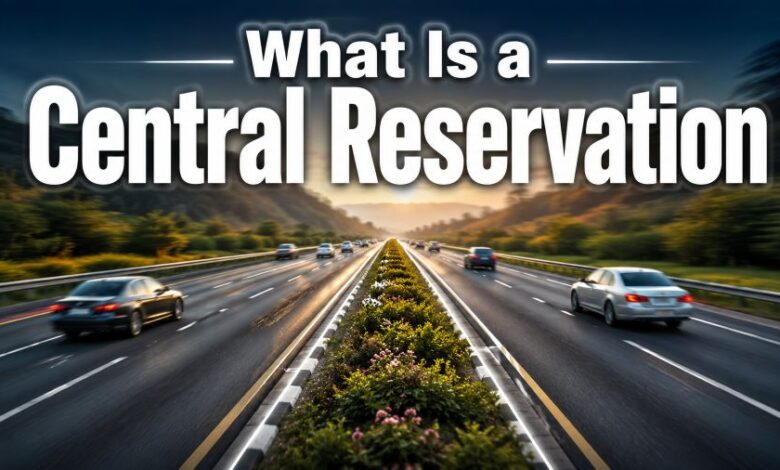
A central reservation is the area in the middle of a divided road that separates vehicles travelling in opposite directions. It is commonly found on motorways, dual carriageways and some large city roads.
A central reservation may be made from grass, concrete, paving or open land. It may also contain a metal safety barrier, road signs, lighting columns or plants.
In British English, it is called a central reservation. In American English, the same road feature is usually called a median or median strip.
The main purpose of a central reservation is to keep opposing traffic apart. It can reduce the risk of vehicles crossing into oncoming lanes and help drivers understand the road layout.
Central Reservation Quick Facts
| Question | Simple Answer |
|---|---|
| What is a central reservation? | The area separating traffic travelling in opposite directions |
| Where is it found? | Motorways, dual carriageways and some urban roads |
| Is it always made from concrete? | No, it may contain grass, paving, barriers or open land |
| Is it the same as a median? | Yes, median is the common American term |
| What colour studs mark it in the UK? | Amber |
| Does it make a road a dual carriageway? | Yes, it separates the two carriageways |
| Can you wait inside it at a junction? | Yes, when your complete vehicle fits safely |
| Can you cross it on a motorway? | Not during normal driving |
What Is the Purpose of a Central Reservation?
The most important purpose of a central reservation is to separate traffic moving in opposite directions.
Vehicles on motorways and dual carriageways may travel at high speeds. Keeping the two traffic flows apart can lower the risk of serious crossover collisions.
A central reservation may also provide space for:
- Metal or concrete safety barriers
- Road signs
- Lighting columns
- Drainage systems
- Bridge or gantry supports
- Grass, plants and landscaping
- Pedestrian refuges on some urban roads
- Authorised emergency and maintenance access
- Waiting space at some right-turn junctions
The design depends on the road. A busy motorway may have a strong concrete barrier, while a wide rural dual carriageway may have a large grass strip.
What Does a Central Reservation Look Like?
A central reservation does not have one standard appearance. It can be narrow or wide and may use several different materials.
Grass Central Reservation
Some roads have a wide grass area between the two carriageways.
It may contain soil, flowers, shrubs or small trees. A safety barrier may run through the middle of the grass, but this is not always required.
Metal Safety Barrier
Many fast roads have a steel barrier inside the central reservation.
The barrier is designed to control or redirect a vehicle that leaves its carriageway. It helps reduce the possibility of the vehicle entering oncoming traffic.
Concrete Barrier
Concrete barriers are often used where road space is limited.
They create a strong physical separation without requiring a wide area of land. Some modern motorways use concrete barriers instead of grass areas with metal barriers.
Raised Paved Divider
Urban roads may use a raised strip made from paving, bricks, kerbs or concrete.
These dividers may also contain traffic signs, lights, pedestrian crossings or decorative plants.
Wide Open Area
On some roads, the carriageways are separated by a large open area.
The two traffic directions may be far apart even when there is no obvious wall or metal barrier.
Is a Central Reservation the Same as a Safety Barrier?
No. A central reservation and a safety barrier are connected, but they do not mean the same thing.
The central reservation is the complete area separating the two carriageways.
A safety barrier is one possible structure placed inside that area.
For example, a central reservation may be:
- A grass strip without a barrier
- A grass strip with a metal barrier
- A narrow concrete divider
- A raised paved island
- A wide area containing signs and lighting
A barrier may form part of the central reservation, but the central reservation is not always a barrier.
How Does a Central Reservation Make a Road a Dual Carriageway?
A dual carriageway is a road with separate carriageways for traffic travelling in opposite directions. The two carriageways are divided by a central reservation.
A common mistake is to believe that every dual carriageway must have two lanes in each direction.
That is incorrect.
The word dual refers to the two separate carriageways, not the number of traffic lanes.
A road can have only one lane in each direction and still be a dual carriageway when a central reservation separates the two sides.
A road may also have several lanes but remain a single carriageway when opposing traffic is not physically separated.
The official Highway Code guidance on dual carriageways and road studs confirms that a dual carriageway has a central reservation separating its carriageways.
Central Reservation vs Single Carriageway
The main difference is whether the opposing directions of traffic are physically separated.
| Single Carriageway | Dual Carriageway |
|---|---|
| Opposing traffic uses the same carriageway | Opposing traffic uses separate carriageways |
| Usually has no central reservation | Has a central reservation |
| May have one or several lanes | May also have one or several lanes |
| National speed-limit rules may be lower | Different national limits may apply |
| Oncoming traffic may be directly beside you | Oncoming traffic is physically separated |
Drivers should examine the road layout and signs rather than simply counting the lanes.
What Colour Studs Mark the Central Reservation?
In the United Kingdom, amber reflective road studs mark the edge of the carriageway beside the central reservation.
Road studs help drivers recognise the road layout at night, in rain and during poor visibility.
The main UK road-stud colours are:
| Stud Colour | What It Marks |
|---|---|
| White | Traffic lanes or the middle of the road |
| Red | The left edge of the carriageway |
| Amber | The edge beside the central reservation |
| Green | Lay-bys and the entrances or exits of slip roads |
| Green and yellow | Temporary lane layouts, usually near roadworks |
An easy way to remember the rule is:
Amber means the central-reservation side.
How to Turn Right Through a Central Reservation
Some dual-carriageway junctions have an opening in the central reservation. This allows drivers to cross the road or turn right.
Before moving, you must decide whether the central reservation is deep enough to protect the full length of your vehicle.
When Your Full Vehicle Fits
When your complete vehicle can fit inside the central reservation without blocking either carriageway, you should treat the two carriageways as separate roads.
Follow these steps:
- Stop and check traffic approaching from the right.
- Wait for a safe gap.
- Cross the first carriageway.
- Wait completely inside the central reservation.
- Check traffic on the second carriageway.
- Complete the turn when there is a safe gap.
Do not move into the middle area unless your entire vehicle can fit safely.
When the Central Reservation Is Too Shallow
When the central reservation cannot contain the full length of your vehicle, do not stop in the middle.
Remain at the original junction until both carriageways are clear enough to cross in one continuous movement.
Highway Code Rule 173 specifically tells drivers to assess the full length of their vehicle before crossing or turning right.
Why Vehicle Length Matters
The central reservation may look large enough from the driver’s seat but still be too small for the rear of the vehicle.
Extra care is needed when driving:
- A van
- A lorry
- A bus or minibus
- A motorhome
- A car towing a caravan
- A vehicle pulling a trailer
- A long commercial vehicle
The rear of a long vehicle must not remain in a live traffic lane while the front waits in the central reservation.
Drivers who are unsure how vehicle use affects classification and road responsibilities can read our guide to commercial and non-commercial vehicles.
Can Two Vehicles Wait in the Central Reservation?
Do not assume that a central-reservation opening has enough room for two vehicles.
Some openings are wide, while others are designed to hold only one vehicle at a time.
Before entering, consider:
- Your vehicle’s full length
- The width of the opening
- The position of another waiting vehicle
- The direction in which each vehicle is turning
- Whether either vehicle would block moving traffic
- Whether your view of the road would be restricted
When another vehicle prevents you from fitting completely inside the central reservation, stay at the junction and wait.
Can You Stop on a Central Reservation?
The answer depends on where the central reservation is located and why you are stopping.
At a Dual-Carriageway Junction
You may wait inside a properly designed central-reservation opening while crossing or turning right, but only when your whole vehicle fits safely.
This is temporary waiting as part of a legal driving movement. It is not parking.
On a Motorway
You must not use the motorway central reservation as a parking place, rest area or turning point.
Stopping there during normal driving is dangerous. Follow signs and instructions from the police, traffic officers or emergency services if an unusual situation requires different action.
Can You Cross a Motorway Central Reservation?
Ordinary drivers must not cross a motorway central reservation during normal driving.
You must not use an emergency or maintenance opening to:
- Turn around
- Reach the opposite carriageway
- Avoid traffic
- Return to a missed exit
- Shorten your journey
When you miss a motorway exit, continue safely to the next available exit.
The official Highway Code motorway rules explain the restrictions on stopping, reversing and crossing the central reservation.
What Are Gaps in Motorway Barriers For?
Some motorway central reservations contain gates, removable sections or paved openings.
These may be used by:
- Police vehicles
- Ambulances and fire engines
- Traffic officers
- Road-maintenance teams
- Recovery vehicles
- Winter-service vehicles
- Authorised traffic during road closures
- Vehicles directed through temporary road arrangements
An opening does not give ordinary drivers permission to cross the motorway.
Only use it when an authorised officer clearly tells you to do so.
Does a Central Reservation Change the Speed Limit?
A central reservation can help identify a road as a dual carriageway, but it does not tell you the exact speed limit on its own.
The legal speed limit depends on:
- Posted speed-limit signs
- The road type
- The vehicle type
- Whether the vehicle is towing
- Temporary roadworks
- Variable motorway signs
- Local restrictions
When the national speed limit applies, cars and motorcycles can normally travel at up to 70 mph on a dual carriageway. However, lower signed limits must always be followed.
Different limits may apply to vans, buses, goods vehicles and vehicles towing trailers.
Speed may be checked by fixed, mobile or average-speed cameras. Our guide to UK speed camera locations explains where different camera systems are commonly used and how they support road safety.
Central Reservation vs Median Strip
A central reservation and a median strip describe the same basic road feature.
The main difference is regional language:
- Central reservation: Mainly used in British English
- Median or median strip: Mainly used in American English
- Central divider: A general term used in several countries
All three terms describe an area separating traffic travelling in opposite directions.
Central Reservation vs Traffic Island
A traffic island is normally smaller and may serve a different purpose.
A traffic island may:
- Guide vehicles around a junction
- Separate lanes for a short distance
- Prevent certain turning movements
- Protect signs or traffic lights
- Give pedestrians a safe waiting point
A central reservation normally continues along a larger section of road and separates two opposing carriageways.
Some central reservations contain pedestrian islands, but the terms are not always interchangeable.
Central Reservation vs Hard Shoulder
A central reservation and a hard shoulder are located in different places.
The central reservation is between opposing directions of traffic.
The hard shoulder is normally beside the left edge of a motorway carriageway.
A hard shoulder may be available for emergencies or opened as a traffic lane when signs allow it. A central reservation must never be treated as an alternative hard shoulder.
Central Reservation vs Hatched Road Markings
Hatched road markings are painted areas containing diagonal lines or chevrons.
They may be used to:
- Separate traffic lanes
- Guide drivers around a hazard
- Protect vehicles waiting to turn
- Keep traffic away from a restricted area
A hatched area does not automatically create a dual carriageway.
A central reservation normally forms a physical separation between two carriageways. Painted markings alone may separate lanes without creating two different carriageways.
Can Pedestrians Use a Central Reservation?
Some central reservations in towns are designed with pedestrian-refuge areas.
These allow pedestrians to cross one direction of traffic, wait safely in the middle and then cross the second direction.
However, people should use a central reservation only when it has a clearly designed crossing or refuge.
Motorway central reservations are not pedestrian areas. Pedestrians should not enter them during normal road use.
Safe Driving Near a Central Reservation
Drivers should remain alert when travelling beside or crossing a central reservation.
Important safety steps include:
- Follow lane markings and road signs
- Keep a safe distance from the vehicle ahead
- Reduce speed when approaching a junction
- Check both directions before crossing
- Judge the full length of your vehicle
- Never rush because another driver is waiting
- Do not enter the middle unless there is enough room
- Use mirrors before changing position
- Take extra care in rain, darkness or poor visibility
Your vehicle should also be safe and stable before a motorway or dual-carriageway journey.
Regular maintenance can identify problems before they affect vehicle control. Our full car service cost guide explains what is normally inspected during a complete service.
A shaking steering wheel or vibration at higher speeds may indicate a wheel problem. Learn more about what happens when car wheels are unbalanced.
Drivers should also check essential fluids before a long journey. Our simple guide explains the correct way to check your engine oil level.
Common Central-Reservation Mistakes
Believing Every Dual Carriageway Has Two Lanes
A dual carriageway can have one or more lanes in each direction. The central reservation is the important feature.
Calling the Barrier the Central Reservation
A barrier can be located inside the central reservation, but it is not always the whole reservation.
Entering a Space That Is Too Small
Do not enter the middle when part of your vehicle would remain in a live lane.
Following Another Vehicle Without Checking
The vehicle ahead may fit inside the reservation while your longer vehicle does not.
Crossing Through a Motorway Emergency Gap
These openings are for authorised use. Missing an exit is not a reason to cross the motorway.
Confusing Amber and Red Studs
Amber studs mark the side beside the central reservation. Red studs mark the left edge of the carriageway.
Assuming Every Dual Carriageway Has a 70 mph Limit
Posted signs can set a lower limit. Always follow the signs currently displayed.
Why Central Reservations Matter for Road Safety
Central reservations make road layouts clearer and keep opposing traffic flows apart.
They can support barriers that help prevent vehicles from crossing into oncoming lanes. They can also provide protected waiting space at some junctions, allowing drivers to cross one carriageway at a time.
However, the central reservation is safe only when drivers use it correctly.
A driver should never enter a central opening without checking:
- The available space
- The full vehicle length
- Traffic from both directions
- Road markings and signs
- The intended direction of travel
- Whether the exit route is clear
Patience is more important than speed. Waiting for a safe gap is always better than blocking a live carriageway.
Frequently Asked Questions
What is a central reservation in simple words?
A central reservation is the area in the middle of a divided road that separates traffic travelling in opposite directions.
Why is it called a central reservation?
It is called central because it is positioned between the two carriageways. Reservation refers to the area being reserved to separate the traffic flows and hold road-safety features.
Is a central reservation the same as a median?
Yes. Central reservation is the common British term, while median or median strip is more common in American English.
What colour studs mark the central reservation?
Amber reflective studs mark the edge beside the central reservation on UK motorways and dual carriageways.
Does every central reservation have a barrier?
No. A central reservation may contain grass, paving, concrete, a metal barrier or open land.
Does a dual carriageway need two lanes in each direction?
No. A dual carriageway can have one or more lanes in each direction. The important feature is the central reservation separating the carriageways.
Can you wait inside a central reservation?
You may wait in a central-reservation opening at a dual-carriageway junction when your entire vehicle fits safely inside it.
What should you do when the central reservation is too narrow?
Wait until both carriageways are clear enough to cross safely in one continuous movement.
Can you stop on a motorway central reservation?
Not during normal driving. It must not be used for parking, resting or turning around.
Can you cross a motorway central reservation?
Not during normal driving. Only cross when an authorised officer directs you to do so.
Is a crash barrier the same as a central reservation?
No. A crash barrier may be installed inside a central reservation, but the reservation is the complete separating area.
Is a traffic island a central reservation?
Not always. A traffic island is usually smaller and may guide traffic or protect pedestrians. A central reservation separates opposing carriageways over a longer section of road.
Conclusion
A central reservation is the area separating traffic travelling in opposite directions on a motorway or dual carriageway.
It may contain grass, concrete, paving, metal barriers, signs or lighting. In the UK, amber road studs mark the carriageway edge beside the central reservation.
The presence of a central reservation is what makes a road a dual carriageway. The number of lanes does not decide this classification.
When crossing or turning right through a central reservation, drivers must check whether the complete vehicle can fit safely in the middle. When it can, each carriageway may be crossed separately. When it cannot, the driver must wait until both carriageways can be crossed in one movement.
Motorway drivers must never use a central reservation to stop, turn around or return to a missed exit during normal driving.
Understanding these simple rules helps drivers recognise road layouts, make safer decisions and avoid dangerous mistakes.