Vauxhall Warning Lights: Symbols and Their Meanings
Understand Vauxhall dashboard warning lights, their colours, common causes, and what to do when a symbol appears on your Corsa, Astra, Mokka or Insignia.

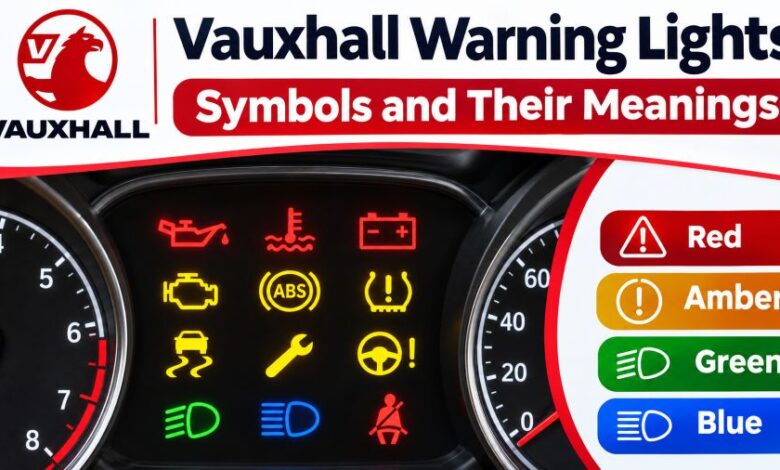
Vauxhall warning lights symbols can look confusing. One moment, your dashboard looks normal. Next, a yellow engine icon or red warning light appears.
What does it mean?
Some lights are simple reminders. Others warn about engine damage, brake problems or overheating. Knowing the difference can help you make a safer decision.
This guide explains the main Vauxhall dashboard symbols, what they mean, and the action each warning needs. It also covers important differences between older and newer UK models.
Quick Facts About Vauxhall Warning Lights
| Quick Fact | Details |
|---|---|
| Car manufacturer | Vauxhall |
| Main warning colours | Red, amber/yellow, green and blue |
| Red warning lights | Serious faults or important reminders |
| Amber warning lights | System faults, maintenance needs or alerts |
| Green dashboard lights | Active vehicle functions |
| Blue dashboard lights | Usually main-beam headlights |
| Common warning | Engine management light |
| Other common alerts | ABS, tyre pressure, oil pressure and service light |
| Popular UK models | Corsa, Astra, Mokka and Insignia |
| Best reference | Official model-specific Vauxhall owner’s manual |
The exact symbol can change between models. Always check the warning message displayed in your car.
What Do Vauxhall Warning Light Colours Mean?
Dashboard warning colours give you the first clue.
But colour isn’t everything. A red parking-brake light can simply mean the handbrake is applied, while a red oil-pressure warning needs immediate attention.
Red Warning Lights: Stop and Check
Red normally indicates something serious.
An engine oil-pressure warning, charging-system fault, overheating alert or brake-system failure may require you to stop immediately.
Find a safe place. Switch off the engine when instructed and arrange help.
Some red lights are reminders. Seat-belt and parking-brake indicators are common examples.
Amber or Yellow Warning Lights: Check the Problem
Amber usually means something needs attention.
Your car might still drive normally. But an engine, ABS, tyre-pressure or steering fault should not be ignored.
Read the message carefully. Get the fault checked promptly.
A flashing amber warning may be more urgent than a steady one.
Green Warning Lights: Normal Operation
Green lights usually show an active feature.
These include dipped headlights, direction indicators and certain cruise-control functions.
No repair is usually needed.
Blue Warning Lights: Lighting Information
Blue normally shows that the main-beam headlights are active.
Switch to dipped beam when required to avoid dazzling other road users.
Red Vauxhall Warning Lights Symbols and Their Meanings
Red warning lights deserve extra attention because some faults can affect your ability to control the car.
| Dashboard Symbol | Meaning | What to Do |
|---|---|---|
| Oil can | Low engine oil pressure | Stop safely and switch off the engine |
| Thermometer with waves | Engine overheating | Stop and let the engine cool |
| Battery with + and − | Charging-system problem | Stop safely and seek assistance |
| Circle containing ! | Brake-system or fluid warning | Stop if it indicates a brake fault |
| Red STOP or warning triangle | Serious vehicle fault | Stop as instructed |
| Person with airbag | Airbag or restraint-system fault | Arrange urgent repair |
| Steering wheel warning | Serious steering-system fault | Stop if steering becomes unsafe |
| Person wearing seat belt | Seat belt unfastened | Fasten the belt |
| Circle containing P | Parking brake applied | Release before driving |
| Flashing parking-brake symbol | Parking-brake operation fault | Read the message and seek repair |
| Open-door symbol | Door or tailgate open | Close it securely |
These symbols are common across Vauxhall model families, though not every car uses the same display.
1. Vauxhall Engine Oil Pressure Warning Light
Symbol: An oil can with a small drop.
Typical colour: Red.
This warning means the engine may not be receiving enough oil pressure.
That is serious.
Without proper lubrication, internal engine parts can suffer severe damage.
Possible causes include low oil, a faulty oil pump, an oil leak or an oil-pressure system problem.
What should you do?
Stop safely and switch off the engine. Do not keep driving just because the engine still sounds normal.
Arrange recovery and inspection.
Remember, oil pressure and oil level are different. Adding oil will not fix every oil-pressure problem.
2. Vauxhall Coolant Temperature Warning Light
Symbol: A thermometer above wavy lines, or a temperature warning on the display.
Typical colour: Red.
Your engine is getting too hot.
A low coolant level, cooling-system leak, thermostat problem or cooling-fan fault may be responsible.
Stop driving safely.
Switch off the engine and allow it to cool. Never remove a hot coolant reservoir cap because the pressurised coolant can cause serious burns.
3. Vauxhall Battery Charging Warning Light
Symbol: A battery showing plus and minus signs.
Typical colour: Red.
This light warns that the battery charging system is not working correctly while the engine runs.
A faulty alternator, drive belt, wiring connection or charging-system component may be involved.
The car could eventually lose electrical power.
Stop safely and arrange assistance. The warning does not automatically mean that replacing the battery will fix it.
4. Vauxhall Brake System Warning Light
Symbol: An exclamation mark inside a circle, often between curved brackets.
Typical colour: Red.
This warning can indicate low brake fluid or another brake-system fault.
First, check whether the parking brake is fully released.
If a brake-system fault remains, do not continue driving. Braking performance may be affected.
Get professional help.
5. Vauxhall Airbag Warning Light
Symbol: A seated person with a circular airbag in front.
Colour: Often red on Vauxhall models.
This warning points to a problem with the airbag system or seat-belt tensioners.
The safety equipment might not work correctly during a collision.
Get the fault repaired promptly.
A separate passenger airbag OFF indicator is different. It shows that the passenger airbag is deactivated, rather than proving there is a fault.
Amber Vauxhall Dashboard Warning Lights Explained
Amber warnings cover several different systems.
Some are maintenance reminders. Others indicate faults affecting braking, steering, emissions or engine performance.
| Symbol | Meaning | Action |
|---|---|---|
| Engine icon | Engine management or emissions fault | Arrange diagnosis promptly |
| Spanner or service symbol | Service reminder or vehicle fault | Check the exact message |
| ABS | Anti-lock braking fault | Have the braking system checked |
| Car with skid marks | Stability or traction-control status | Check whether flashing or steady |
| Tyre with ! | Tyre-pressure loss or monitoring fault | Inspect tyres safely |
| Steering wheel with warning | Power-steering problem | Seek urgent inspection |
| Exhaust filter | DPF or exhaust-filter warning | Follow the handbook |
| AdBlue warning | Low AdBlue or emissions-system problem | Refill or arrange diagnosis |
| Coil-shaped icon | Diesel glow-plug preheating | Wait for the light to go out |
| Fuel-pump icon | Low fuel | Refuel soon |
| Brake-pad symbol | Brake pads worn | Arrange inspection |
| Bulb warning | Exterior lighting fault | Check and repair the lamp |
| Gearbox warning | Transmission problem | Seek professional inspection |
| Car between lane lines | Lane-assistance status or fault | Read the display message |
| Collision warning | Forward-collision or braking alert | Respond to any immediate hazard |
Not all amber indicators mean something has failed. A diesel glow-plug light, for example, normally appears during cold-weather engine preheating.
Vauxhall Engine Management Light: Why Is It On?
The Vauxhall engine management light is one of the most recognised dashboard alerts.
It looks like a small engine.
The light may appear because of an engine-control or emissions-system problem.
Possible causes include:
- Faulty engine sensors
- Ignition misfires
- Fuel-injection problems
- Exhaust emissions faults
- Wiring or electrical problems
- Other engine-management faults
A steady amber light normally calls for prompt professional diagnosis.
A flashing light is more serious.
Vauxhall manuals warn that a flashing engine malfunction indicator can signal a fault capable of damaging the catalytic converter.
Ease off the accelerator. If the car is misfiring, running badly or losing power, stop safely and arrange assistance.
A mechanic can read the diagnostic trouble codes. These help identify the affected system, though further testing may be needed to find the actual fault.
What Does the Spanner Light Mean on a Vauxhall?
The Vauxhall spanner light causes confusion.
Actually, it can mean different things.
On certain models, a spanner accompanies a routine service reminder. On others, a service-vehicle-soon warning signals an electronic or mechanical fault.
That difference matters.
Spanner Light for Routine Servicing
A maintenance display may tell you that an oil change or scheduled service is due.
Book the required service and follow the correct reset procedure after the work is completed.
Spanner Light for a Vehicle Fault
A warning with a service-vehicle-soon message can indicate a fault requiring workshop attention.
The 2023 Corsa manual, for example, treats its service display separately from its service-vehicle-soon warning.
What should you check?
Look at the dashboard text. Check whether another warning has appeared alongside the spanner.
Do not assume every spanner light needs only a service reset.
Vauxhall ABS Warning Light
Symbol: ABS inside a circle or curved brackets.
Typical colour: Amber.
ABS helps prevent wheel lock during heavy braking.
If the ABS warning remains on, the anti-lock system may have a fault.
The normal braking system can remain operational, but ABS regulation may be unavailable.
This means your wheels could lock during hard braking, particularly on slippery roads.
Drive cautiously if the car brakes normally, and arrange repair as soon as possible.
If the red brake warning also appears, stop safely and seek assistance.
Vauxhall Tyre Pressure Warning Light
Symbol: A tyre-shaped outline with an exclamation mark.
Typical colour: Amber.
This alert warns that one or more tyres may have lost pressure.
A puncture, slow air leak or normal pressure loss could explain it.
Stop somewhere safe. Check each tyre for visible damage and measure the pressures.
Use the recommended figures on your vehicle’s tyre-pressure label or in its handbook.
A flashing warning can indicate a monitoring-system fault on some models.
After correcting the problem, follow your vehicle’s tyre-pressure reset or reinitialisation instructions.
Never reset the warning just to hide low pressure.
Vauxhall Traction Control Warning Light
Symbol: A car with two curved skid marks underneath.
Typical colour: Amber.
This symbol relates to electronic stability control or traction control.
A flashing light often means the system is actively working to control wheel slip.
That can happen on wet, icy or loose surfaces.
A steady light may mean the system has been switched off or a fault has been detected.
Check the dashboard message and the vehicle’s stability-control settings.
If a fault remains, arrange inspection.
Vauxhall DPF Warning Light on Diesel Cars
Some diesel Vauxhall models use a diesel particulate filter, known as a DPF.
It catches soot in the exhaust.
Short journeys can prevent the filter from completing its normal cleaning cycle.
A DPF warning may appear when the filter needs regeneration or when the emissions system has a problem.
What Should You Do?
Read your vehicle’s handbook first.
For some Vauxhall diesel models, driving at a suitable speed for a sustained period can allow an early filter warning to clear.
The 2023 Corsa manual describes a cleaning procedure involving at least 40 mph when an initial exhaust-filter saturation warning appears.
That instruction is model-specific.
If the warning stays on, other fault lights appear or the car enters reduced-power mode, arrange professional diagnosis.
Do not attempt a regeneration drive when the car has a serious engine fault or a red stop warning.
Vauxhall AdBlue Warning Light
AdBlue is used by certain diesel engines to reduce nitrogen oxide emissions.
Your dashboard may show an AdBlue symbol or a message about remaining driving range.
A low level needs attention.
If the required AdBlue is not added, some vehicles will eventually prevent the engine from restarting.
For example, the 2023 Corsa handbook describes different warnings as the remaining AdBlue driving range falls.
But the exact distances vary by model.
Use the message shown on your own dashboard and add the correct fluid as instructed.
If a warning remains after refilling, an emissions-system fault may need professional diagnosis.
Green and Blue Vauxhall Dashboard Symbols
Many dashboard symbols simply tell you which features are working.
| Symbol | Colour | Meaning |
|---|---|---|
| Flashing left/right arrows | Green | Direction indicators |
| Headlamp with downward beams | Green | Dipped headlights |
| Headlamp with straight beams | Blue | Main-beam headlights |
| Headlamp with A | Green or another status colour | Automatic high-beam assistance |
| Front fog-light icon | Green | Front fog lights active |
| Rear fog-light icon | Amber/yellow | Rear fog light active |
| Speedometer symbol | Green or white | Cruise-control status |
| A inside a circle | Green | Automatic stop-start activity |
| READY | Green | Electric or hybrid vehicle ready |
| Lane-marking symbol | Green or another status colour | Lane-assistance status |
| Rain-sensor symbol | Green | Automatic wiper setting |
| Gear-change arrow | Display-dependent | Recommended gear change |
The rear fog-light symbol is an interesting exception.
It may appear amber even though there is no fault. It simply shows that the rear fog light is switched on.
Vauxhall Corsa Warning Lights and Their Meanings
The Corsa is one of Vauxhall’s best-known UK cars.
Older Corsa dashboards and newer digital displays do not look identical.
Older Vauxhall Corsa Models
Older versions may use simpler warning lamps and smaller information displays.
Drivers commonly need to identify engine-management, service, ABS, airbag and tyre-pressure warnings.
Read the warning alongside any message or fault code shown by the car.
Newer Vauxhall Corsa Models
Newer models can show more detailed messages about driver-assistance equipment, emissions systems and vehicle electronics.
On the 2023 Corsa, the handbook lists warnings for lane-keep assist, active emergency braking, tyre-pressure loss, the exhaust filter and other fitted systems.
The electric version also has charging and electric-drive indicators.
A warning described for a diesel Corsa will not necessarily apply to an electric Corsa.
Vauxhall Astra Dashboard Symbols and Meanings
Astra warning symbols also vary by generation.
Older Vauxhall Astra Models
Older Astra manuals include familiar indicators for engine management, ABS, power steering, traction control and diesel filter systems.
Some versions also include adaptive forward lighting, parking assistance and electronic parking-brake warnings.
Newer Vauxhall Astra Models
Recent Astra models may display more detailed warning messages through the digital instrument cluster.
Petrol, diesel, hybrid and electric equipment differs according to model and year.
The spanner symbol deserves attention here, too. A service reminder is not always the same as a service-vehicle-soon fault.
Use the correct Astra handbook before resetting anything.
Vauxhall Mokka Warning Lights
The original Mokka, Mokka X and newer Mokka use different dashboard designs and electronic systems.
Older models feature conventional engine, braking, steering and stability warnings.
Newer vehicles can include alerts for lane assistance, emergency braking and electric-drive equipment.
Mokka Petrol and Diesel Warnings
Combustion-engine versions may display engine-management, coolant, oil-pressure and emissions warnings.
Diesel-specific symbols only apply where the relevant equipment is fitted.
Mokka Electric Warning Lights
Electric Mokka models have battery, charging and electric-drive indicators.
A charging-cable icon may simply tell you that the cable remains connected.
A serious high-voltage battery or electric-drive warning is different. Follow the exact dashboard instruction and seek assistance.
Vauxhall Insignia Warning Symbols
The Insignia has used several different instrument clusters.
Older versions can have warnings for adaptive lighting, electronic parking brakes, traction control and steering systems.
Depending on specification, some also have advanced chassis or driving-assistance indicators.
The owner’s manual distinguishes ordinary operating indicators from actual faults.
For example, a cruise-control light can show that the feature is active, while an amber ABS warning can indicate that the anti-lock system is unavailable.
Check the Insignia’s model year before applying a warning description found online.
Other Vauxhall Car Warning Symbols
Some less familiar indicators appear only on selected vehicles.
| Warning Symbol or System | Possible Meaning |
|---|---|
| Immobiliser/key warning | The vehicle cannot recognise the key or has an immobiliser fault |
| Gearbox warning | Automatic transmission or gearbox electronics fault |
| Easytronic warning | Automated manual transmission fault on equipped older models |
| Parking assistance warning | Parking sensor system fault or obstacle alert |
| Brake-pad wear warning | Brake pads need inspection or replacement |
| Bulb failure symbol | An exterior lamp may not work |
| Washer fluid warning | Windscreen washer level is low |
| Water in diesel fuel filter | Water needs removal from the fuel-filter system |
| Adaptive lighting warning | Fault affecting the adaptive headlight system |
| Lane departure warning | Lane warning active, intervention occurring or system fault |
| Forward collision warning | Potential collision hazard or safety-system issue |
| Driver-attention warning | Driver-alert function has detected a condition needing attention |
| Reduced-power warning | Engine or electric-drive performance is being limited |
| Suspension warning | Fault in a fitted electronic or air-suspension system |
| Charging-plug indicator | Electric-vehicle charging cable remains connected |
These features are not fitted to every Vauxhall.
The displayed colour and accompanying message help explain whether a light is a warning or a normal system indication.
Can You Drive With a Vauxhall Warning Light On?
Sometimes you can. Sometimes you shouldn’t.
The decision depends on the exact symbol, whether it is flashing and how the car is behaving.
| Warning | Can You Continue Driving? |
|---|---|
| Red oil-pressure light | No. Stop safely and switch off the engine |
| Red overheating light | No. Stop and allow the engine to cool |
| Red brake-system fault | No. Stop and arrange assistance |
| Red charging-system warning | Stop safely and seek help |
| Steady amber engine light | Only if safe; arrange prompt diagnosis |
| Flashing engine light | Avoid continued driving; seek urgent help |
| ABS warning alone | Normal braking may remain; drive cautiously and seek repair |
| Tyre-pressure warning | Stop safely to inspect tyres before continuing |
| Service reminder | Usually possible if it is only routine maintenance |
| Green headlight indicator | Yes. Normal operation |
Never rely on colour alone.
A strange noise, heavy steering, poor braking or major power loss can make an otherwise ordinary warning much more serious.
Why Do Vauxhall Dashboard Warning Lights Stay On?
A warning should normally disappear after the related issue is fixed or the relevant system completes its start-up check.
Sometimes it stays on.
Possible reasons include an unresolved fault, a faulty sensor, an electrical problem or a required system reset.
Low battery voltage can also affect several vehicle electronics.
Still, don’t guess.
Read the dashboard message and arrange diagnostic testing where needed.
A diagnostic scanner can read stored fault codes, but proper testing is required before deciding which part needs repair.
How to Reset Vauxhall Warning Lights
Different warning lights have different reset procedures.
A service reminder may have a manual reset process. Some tyre-pressure systems also need reinitialisation after checking and correcting tyre pressures.
An engine-management or ABS fault is different.
Fix the underlying problem first.
Clearing a stored code without fixing the cause can make the warning return. It can also hide a fault that still needs attention.
Use the instructions for your exact Vauxhall model and year.
Do Vauxhall Dashboard Warning Lights Affect the UK MOT?
Yes, certain warning lights can cause an MOT failure.
UK MOT rules include checks on relevant malfunction indicators for engine emissions, ABS, electronic stability control and supplementary restraint systems.
An engine malfunction light indicating a fault can be classed as a major defect where the relevant testing rule applies.
A faulty airbag warning system may also lead to failure.
But every dashboard light is not an MOT failure.
A passenger airbag OFF indicator, for example, does not automatically mean there is a defective airbag.
The rules depend on the system, the fault and the vehicle’s age or type.
Get genuine faults repaired before the MOT rather than simply clearing warning codes.
How to Find the Correct Vauxhall Warning Light Meaning
Start with your model.
Check its year and engine type. Then find the correct handbook.
Vauxhall provides owner’s manuals covering older and newer cars, including the Corsa, Astra, Mokka and Insignia.
Look under the instrument panel or control-indicator section.
Compare the symbol, colour and any displayed message.
If the warning remains unclear, a qualified technician can inspect the vehicle.
Final Thought
Vauxhall warning lights symbols are easier to understand once you know what each colour and icon means.
Some simply show that a feature is active. Others need a quick check or professional repair.
Red oil, brake and overheating warnings need particular care.
Don’t ignore a flashing engine light, either.
And remember, model years matter. A Corsa warning may look different from one on an Astra or Mokka.
Use the correct handbook, read the full dashboard message and deal with faults before they become bigger problems.
Frequently Asked Questions (FAQs)
1. What do Vauxhall dashboard warning lights mean?
They show vehicle information, active functions or possible faults. Red generally signals urgent attention, amber calls for checking, and green usually confirms normal operation.
2. What does the spanner light mean on a Vauxhall?
It can indicate scheduled servicing or a service-vehicle-soon fault, depending on the model. Check the accompanying message before taking action.
3. Why is my Vauxhall engine warning light on?
Possible causes include engine-control, sensor, ignition or emissions problems. A diagnostic check can help identify the fault.
4. What does the yellow warning light mean on a Vauxhall Corsa?
It depends on the symbol. Common amber warnings relate to engine management, ABS, tyre pressure, stability control or maintenance. A flashing light can indicate a more urgent condition.
5. What do Vauxhall Astra dashboard symbols mean?
They show the status of systems such as the engine, brakes, steering, tyres and vehicle lighting. The exact meaning depends on the Astra generation and the warning message.
6. Can I drive my Vauxhall with a warning light on?
Some warnings allow cautious driving to a suitable repair location. Serious red faults may require an immediate stop. Never continue if the car is unsafe.
7. Why do multiple Vauxhall warning lights appear together?
Several warnings may be related to one underlying problem, such as an electrical or charging-system fault. They can also indicate separate faults, so proper diagnosis is important.
8. Will a Vauxhall engine management light fail an MOT?
It can. Under UK MOT rules, an engine malfunction indicator showing a fault is a major defect when the relevant inspection requirement applies to that vehicle.