How to Top Up Engine Oil in Your Car Safely
Learn how to choose the right engine oil, find the filler cap, add the correct amount, and protect your car from costly mistakes.

Your car needs engine oil. Without enough, things go wrong fast.
Engine oil keeps moving parts lubricated. It reduces friction and helps control heat. But the oil level can drop over time.
The good news? You can usually fix a low oil level yourself.
Learning how to top up engine oil isn’t difficult. You just need the correct oil, a little care, and a few minutes.
Still, one mistake can cost you. Too much oil is a problem. The wrong grade can cause trouble, too.
Here is how to handle the job safely.
Quick Facts About Topping Up Engine Oil
| Question | Quick Answer |
|---|---|
| Can you top up engine oil yourself? | Yes, on most cars |
| Where do you add engine oil? | Through the engine oil filler opening |
| What engine oil should you use? | The grade and specification stated in your handbook |
| Should the engine be running? | No, for a normal dipstick-based top-up |
| How much oil should you add? | Small amounts until the level is correct |
| What should the dipstick show? | Oil between MIN and MAX |
| Can too much oil damage an engine? | Yes |
| Is a funnel necessary? | Recommended to prevent spills |
| Does topping up replace an oil change? | No |
What Do You Need Before Adding Engine Oil?
Get everything ready first.
You don’t need expensive equipment. Most drivers already have the basics.
Here’s what to keep nearby:
- Correct engine oil for your car
- Clean funnel for easy pouring
- Paper towel or lint-free cloth
- Protective gloves
- Vehicle owner’s manual
The manual matters most here. It tells you which oil your engine needs.
Never guess the oil grade. Two cars from the same manufacturer may need different products.
Also, use a clean funnel. Dirt inside the engine isn’t welcome.
How to Choose the Correct Engine Oil
This is where drivers sometimes slip up.
You visit a shop. You see several bottles marked 5W-30. They look almost identical.
But they’re not always interchangeable.
Your engine needs a particular motor oil viscosity and performance specification. The correct choice depends on its design.
Understand Engine Oil Grades
You might see these common labels:
- 0W-20
- 0W-30
- 5W-30
- 5W-40
The first number, before W, describes cold-temperature viscosity behaviour. The second number describes viscosity at higher operating temperatures.
The letter W means winter.
For example, 5W-30 and 5W-40 are different viscosity grades. Neither is automatically better for every engine.
Check your handbook before buying.
Check the Manufacturer’s Oil Approval
Viscosity isn’t the whole story.
Your vehicle may also require a specific oil standard.
Look for:
- ACEA specifications
- API performance categories
- Manufacturer oil approvals
- Recommended SAE viscosity grade
For example, some Volkswagen engines require oils meeting particular VW approvals.
Other manufacturers have their own requirements.
The exact approval matters. It should match the vehicle’s handbook, not just the oil bottle’s front label.
Some diesel engines with particulate filters also need specific low-ash oils.
So read the label carefully.
Synthetic or Conventional Engine Oil?
You’ll find synthetic, semi-synthetic, and conventional engine oils.
Full synthetic oil is common in modern engines. But the base oil description alone doesn’t tell you whether a product is suitable.
The correct specification comes first.
If you’re unsure, ask a qualified mechanic or check the manufacturer’s oil recommendations.
How to Top Up Engine Oil in Your Car
Ready to add the oil?
The process is fairly simple. But don’t rush the pouring.
1. Park Your Car on Level Ground
Find a flat parking space.
Apply the parking brake. Switch off the engine.
Allow it to cool enough to work safely. If you have recently driven, follow the handbook’s recommended waiting period.
A sloping surface can affect the oil reading. Hot engine parts can also burn your hands.
2. Check Your Current Oil Level
Before adding anything, check the dipstick.
Remove it and wipe it clean. Push it fully back into place.
Pull it out once more.
Look at the oil marks.
Most dipsticks show minimum and maximum levels.
If the oil is between these marks, it may not need topping up. If it’s near or below MIN, add the correct oil as directed by the handbook.
Some modern cars use electronic oil-level displays instead. Follow their specific instructions.
3. Find the Engine Oil Filler Cap
Open the bonnet securely.
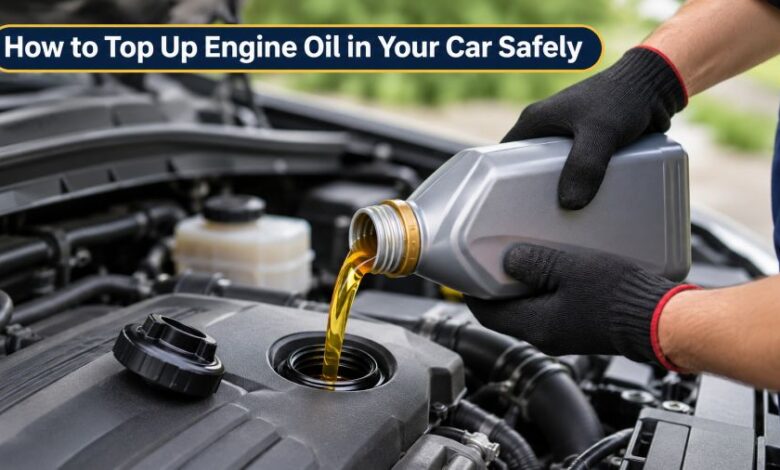
Look for the engine oil filler cap. It’s commonly found on top of the engine.
You’ll usually see an oil-can symbol or the word OIL.
Make sure you have the correct opening.
Don’t confuse it with the coolant tank, brake-fluid reservoir, or windscreen washer bottle.
You should pour engine oil through the oil filler opening, not into another reservoir.
4. Remove the Oil Filler Cap
Unscrew the cap carefully.
Keep it somewhere clean and safe.
Before pouring, inspect the area. Make sure loose dirt cannot fall into the opening.
A clean filler opening helps keep unwanted material out of the engine.
5. Add a Small Amount of Engine Oil
Now comes the main part.
Place a clean funnel inside the oil filler opening. Open your oil bottle.
Start pouring slowly.
Don’t empty the bottle.
For a cautious top-up, you can add around 100–200 ml at a time when the amount needed is uncertain, then check again.
This is a practical approach, not a fixed requirement for every car.
A small measured amount gives you more control.
It also reduces the chance of oil overfilling.
6. Wait and Check the Oil Level Again
Stop pouring.
Give the added oil time to drain into the sump. This may take a few minutes.
Now check the dipstick again.
Wipe it clean before taking a fresh reading.
Is the oil still low?
Add another small amount if needed. Keep checking between additions.
The aim is a correct reading between MIN and MAX.
You don’t need to reach the absolute maximum mark.
7. Replace the Oil Filler Cap
Once the level is correct, stop.
Remove your funnel carefully.
Refit the engine oil filler cap. Make sure it is properly secured.
Replace the dipstick, too.
Wipe up any spilled oil. Check that no tools remain under the bonnet.
Your engine oil top up is complete.
If an oil-pressure warning is active, don’t assume adding oil has fixed the underlying problem. Have the fault checked before driving.
How Much Engine Oil Should You Top Up?
There isn’t one amount for every car.
It depends on your engine and how low the oil is.
On many vehicles, the difference between MIN and MAX on the dipstick is approximately one litre.
But that’s not universal.
Your car oil capacity might be four, five, or more litres during a complete oil change. That doesn’t mean you should pour that amount in during a top-up.
A top-up and an oil change are different jobs.
If the oil sits slightly below the middle of the dipstick range, only a small addition may be needed.
If it’s near MIN, more may be required.
Add gradually. Check each time.
Never use the full engine oil capacity as your topping-up amount.
What Happens If You Overfill Engine Oil?
Too much engine oil can cause real problems.
Excess oil may become aerated when moving engine parts come into contact with it. That can interfere with lubrication.
It may also contribute to leaks or other engine problems.
Possible signs include:
- Blue-grey exhaust smoke
- Oil leaks
- Rough engine running
- Unusual oil consumption
- An oil level above MAX
These symptoms can have other causes, too.
If the level is above MAX, confirm the reading using the manufacturer’s procedure.
Don’t add anything else.
If the engine is overfilled, arrange to have the excess oil removed before driving.
A mechanic can handle that safely.
Can You Add Engine Oil When the Engine Is Hot?
Sometimes the engine will still be warm.
That doesn’t mean you should rush.
For a conventional dipstick-based top-up, switch off the engine and allow it to cool enough to work safely.
The AA recommends waiting around 5–10 minutes after driving before checking the oil. Castrol advises at least 20 minutes in its topping-up instructions.
Vehicle procedures differ.
Your owner’s manual takes priority.
Never open the oil filler while the engine is running for a routine top-up.
And watch those hot metal parts.
Can You Mix Different Engine Oil Brands?
Yes, in some situations.
Different brands of engine oil may be mixed if they meet the required viscosity and performance specifications.
But don’t rely on the brand name alone.
For example, two 5W-30 products may have different manufacturer approvals.
Mixing unsuitable oils could mean the combined oil no longer meets your engine’s requirements.
The safer choice is to use oil that meets the exact specification given in your handbook.
If you don’t know what’s already inside the engine, speak to a mechanic before choosing a replacement.
How Do You Know When Engine Oil Needs Topping Up?
The most dependable way is an accurate oil-level reading.
If the dipstick shows a low level, your engine may need more oil.
Some cars display a low oil-level warning, too.
But don’t confuse that with a red oil-pressure warning.
A red oil-pressure warning needs immediate attention.
If it appears while driving, stop as soon as it is safe. Switch off the engine.
Low oil pressure can damage internal engine parts very quickly. Adding oil won’t fix every possible cause.
For a complete explanation of dipstick readings, check timing, and how often to inspect your oil, read our guide to checking your engine oil level.
Common Mistakes When Adding Oil to a Car Engine
A few mistakes are easy to avoid.
Pouring Oil Too Quickly
Large amounts are harder to control.
Add a little. Then check.
Choosing Oil by Viscosity Alone
A 5W-30 label isn’t enough.
Check the full engine oil specifications and manufacturer approval.
Forgetting the Filler Cap
An unsecured cap may allow oil to escape.
Always check it before closing the bonnet.
Topping Up Without Checking
Don’t add oil just because you haven’t checked it recently.
Measure first. Add only what is needed.
Ignoring Oil Leaks
Does the oil level keep dropping?
Look for signs of leakage. Have unusual oil consumption investigated by a mechanic.
Topping up won’t repair a leaking seal or damaged component.
Does Topping Up Engine Oil Replace an Oil Change?
No. They’re different.
Topping up adds fresh oil to the existing lubricant.
An oil change removes the used oil. During a routine oil service, the oil filter is normally replaced too.
Fresh oil added during a top-up doesn’t remove accumulated contamination from the old lubricant.
Keep following your manufacturer’s service schedule.
That matters even if the oil level stays normal.
When Should You Check the Engine Oil Level?
When Should You Visit a Mechanic?
Some problems need more than an oil bottle.
Seek professional help if:
- The oil level keeps falling unusually quickly.
- You notice a significant oil leak.
- The engine makes knocking or scraping noises.
- A red oil-pressure warning appears.
- The oil level is above MAX.
- You accidentally add the wrong fluid.
- The oil-level reading appears abnormal or unreliable.
Don’t keep driving with a serious lubrication warning.
A garage can inspect the engine and identify the cause.
Final Thought
Knowing how to top up engine oil can save you a garage visit for a simple maintenance job.
The method is straightforward.
Choose the correct oil. Find the filler cap. Add small amounts.
Then check the level again.
Don’t rush. Don’t overfill.
And if something doesn’t look right, get it checked before driving.
A careful top-up helps keep your engine properly lubricated. That’s the whole point.
Frequently Asked Questions
1. Can I top up engine oil myself?
Yes. Most drivers can do this at home. Use the correct engine oil, follow the vehicle handbook, and check the level carefully.
2. How much engine oil should I top up?
It depends on the existing level. Add small measured amounts and check again. Never assume the engine needs a full bottle.
3. Can I put engine oil in my car without a funnel?
Yes, but a clean funnel makes pouring easier. It also helps prevent spills around the filler opening.
4. Can you add engine oil when the engine is hot?
Follow your vehicle’s instructions. For a normal dipstick-based top-up, switch off the engine and let it cool enough to work safely.
5. What happens if you overfill engine oil?
Excess oil can interfere with lubrication and may cause leaks or engine damage. Have a confirmed overfill corrected before driving.
6. Can I mix different brands of engine oil?
Often, yes, if both products meet your engine’s required specifications. Matching the viscosity number alone is not enough.
7. How do I know if my engine oil needs topping up?
Check the dipstick or the vehicle’s electronic oil-level display. If the reading is low, follow the manufacturer’s topping-up instructions.
8. Does topping up engine oil mean I can skip an oil change?
No. Topping up restores the level. It doesn’t replace used oil or the oil filter. Follow your normal servicing schedule.