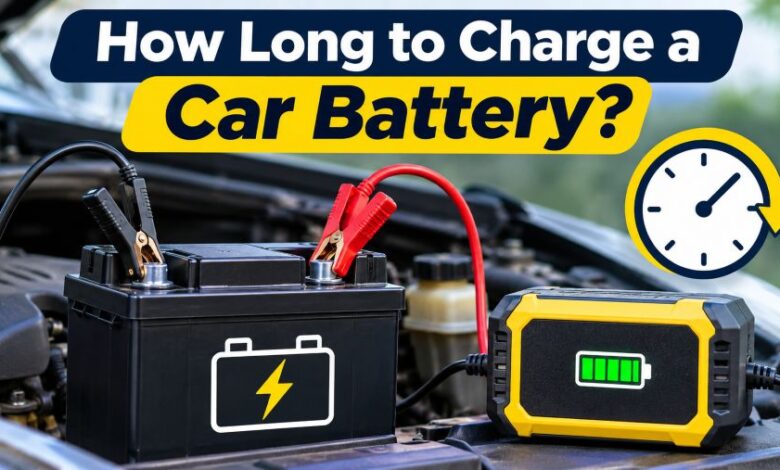
How Long to Charge a Car Battery? Charging Times Explained
Find out how many hours your car battery needs, what changes charging speed, and why driving alone may not be enough.

Introduction
A flat car battery is frustrating. You turn the key. Nothing happens.
Now comes the big question. How long should you charge it?
Most car batteries need several hours. Some take the whole night. Others may need much longer.
The answer depends on the battery, charger output, and how much power is left.
A standard 12V car battery often takes 10 to 24 hours for a full charge using a typical charger, though charging can be quicker or slower. Low-power trickle chargers may take two days or more.
Here is what you should know.
Quick Facts About Car Battery Charging
| Detail | Information |
|---|---|
| Main battery type | 12V starter battery |
| Common battery capacity | Around 40–80Ah in many passenger cars |
| Typical full charging time | Often 10–24 hours with a standard charger |
| Partially discharged battery | May recharge in several hours |
| 2-amp charger | Slow charging, often overnight or longer |
| 5-amp charger | Suitable for many standard car batteries |
| 10-amp charger | Faster charging when compatible |
| Trickle charger | May take 24–48 hours or longer |
| Driving after jump-starting | Around 30 minutes can restore some charge |
| Best charging option | Compatible automatic smart charger |
These times are general estimates. Your actual result may differ.
How Long Does It Take to Charge a Car Battery?
Most drivers want one number. Unfortunately, there isn’t one.
A battery that’s half full charges faster than one that’s almost empty. A stronger charger may also cut charging time.
Take a 60Ah battery, for example.
If it starts at 50% charge, a compatible 5-amp charger may take around six to eight hours to restore it.
Use a weaker charger, though, and the process takes longer.
Car Battery Charging Time by Amperage
The table below uses a 60Ah battery starting at approximately 50% charge.
| Charger Output | Approximate Charging Time |
|---|---|
| 1 amp | 36–48+ hours |
| 2 amps | 18–24+ hours |
| 4 amps | 9–12+ hours |
| 5 amps | 7–10 hours |
| 10 amps | 4–6 hours |
| 15 amps | 3–5 hours |
| 20 amps | 2–4 hours |
These are planning estimates, not fixed charging times. The charger may lower its current as the battery approaches full charge.
Higher amperage can reduce charging time. But faster isn’t always better.
Use only a charging current approved for your battery.
What Affects Car Battery Charging Time?
Several things change the result. Some make a big difference.
Battery Size
Battery capacity is measured in amp-hours, or Ah.
A 40Ah battery usually needs less charging time than a 100Ah battery, assuming both have the same starting charge percentage and charger output.
Check the label first. The capacity is usually printed there.
Current Battery Charge
A nearly full battery needs less power.
For example, a battery sitting at 80% charge generally needs less charging than the same battery at 20%.
The starting charge level matters. A lot.
Charger Output
Charger current is measured in amps.
A 2A charger supplies less current than a 10A charger. So the lower-output unit generally takes longer.
The battery must support the selected current.
Battery Age and Condition
Old batteries can cause trouble.
Over time, batteries lose capacity. Internal damage or sulfation may also prevent normal charging.
A badly damaged battery might never charge properly.
Temperature
Temperature changes battery behaviour.
Cold conditions can slow charging. Excessive heat can damage battery components.
A quality smart charger may adjust its output when conditions are unsuitable.
Battery Type
Not every battery charges alike.
Flooded lead-acid, AGM, EFB, and lithium batteries may need different charging settings.
Always identify your battery first.
How Long to Charge a Dead Car Battery?
A dead battery doesn’t always mean a broken battery.
Sometimes, it’s simply discharged.
Maybe you left the lights on. Maybe the car sat unused.
A deeply discharged battery can take many hours to recover using an appropriate charger.
Some smart chargers won’t begin charging when voltage falls below their detection limit.
This doesn’t automatically confirm battery failure.
Still, don’t bypass charger protection. Have the battery checked first.
A battery with damaged cells may need replacement rather than another charging attempt.
How Long to Charge a Car Battery at 2 Amps?
A 2-amp charger works slowly.
For a 50Ah battery discharged from full to near empty, the ideal charging calculation gives about 25 hours. Actual charging may take longer.
For larger batteries, expect additional time.
This option can suit gentle charging. But patience is needed.
How Long to Charge a Car Battery at 5 Amps?
A 5-amp smart charger suits many passenger-car batteries.
CTEK gives an example of a 60Ah battery at 50% charge taking around six to eight hours with a compatible 5A charger.
A nearly empty battery takes longer.
Check your charger specifications before starting.
How Long to Charge a Car Battery at 10 Amps?
A 10-amp charger can save time.
Consider a 60Ah battery that’s half charged. Replacing the missing 30Ah takes at least three hours at a constant 10A in ideal conditions.
Actual charging takes longer.
Around four to six hours is a reasonable illustration, but the charger and battery determine the real result.
Don’t force a high charging current.
How Long Does a Trickle Charger Take?
Trickle chargers deliver low current.
Some supply just one or two amps.
Charging a heavily discharged car battery may take 24–48 hours or several days.
A traditional trickle charger isn’t necessarily suitable for continuous connection.
A battery maintainer works differently. It is intended to keep a charged battery ready during storage.
Many smart chargers include maintenance modes.
Use the manufacturer’s instructions before leaving any device connected for long periods.
How Long Does Driving Take to Charge a Car Battery?
Driving helps recharge a battery.
But there’s a catch.
Your car’s alternator supplies electrical power while the engine runs. It also replaces some of the energy used during starting.
A 30-minute drive may restore enough charge for another start.
That doesn’t mean the battery is full.
A deeply discharged battery may need hours of driving to recover substantially. Even then, the result isn’t guaranteed.
Modern vehicles also manage electrical demand differently.
A proper battery charger gives you better control.
Is 30 Minutes Enough After a Jump Start?
The RAC recommends driving for at least 30 minutes in normal conditions after a jump-start.
That helps restore some charge.
A full recharge is another matter. It is best completed using a suitable charger.
If the engine struggles again, get the battery and charging system tested.
Does Idling Charge a Car Battery?
Yes, idling may provide some charging current.
But it often works slowly.
Electrical accessories consume alternator output. So less power may reach the battery.
Leaving the engine idling for hours isn’t a reliable way to restore a deeply discharged battery.
Use a smart charger instead.
How to Calculate Battery Charging Time
You can estimate charging time yourself.
Start with three numbers.
- Battery capacity in Ah
- Current charge percentage
- Charger output in amps
Use this formula:
Ideal Charging Time = Missing Battery Capacity (Ah) ÷ Charger Output (A)
For example:
Battery capacity: 60Ah
Starting charge: 50%
Missing charge: 30Ah
Charger output: 5A
30 ÷ 5 = 6 hours
Six hours is the ideal minimum at a constant 5A.
Real charging takes longer because of charging losses and reduced current near full charge.
The calculation helps with planning. It doesn’t replace the charger’s full-charge indication.
How to Charge a Car Battery Safely
Charging is usually straightforward. But safety comes first.
1. Park the car safely.
Switch off the engine. Choose a well-ventilated charging location.
2. Check the battery.
Look for cracks or leaks. Don’t charge a damaged or frozen battery.
3. Select a suitable charger.
Check the battery voltage and chemistry. Use the correct charging program.
4. Connect the charger.
With mains power disconnected, connect the positive clamp to the approved positive charging terminal.
Connect the negative clamp to the specified negative charging point or chassis ground, following the vehicle manual.
Some modern cars use battery management systems. Their approved charging connections matter.
5. Start charging.
Connect power and start the selected charging program.
Watch for warnings or abnormal heating.
6. Wait for completion.
Allow the smart charger to finish. Don’t assume a fixed number of hours means full charge.
7. Disconnect safely.
Switch off and unplug the charger.
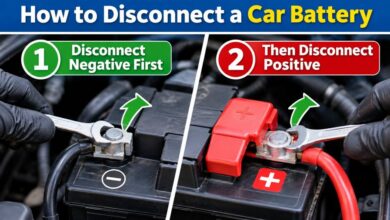
Then remove the clamps as instructed, usually negative first.
Never smoke near a charging battery. Lead-acid batteries can release flammable gas.
If you’re unsure about connections, ask a qualified technician.
Can You Charge a Car Battery Overnight?
Yes, with the right charger.
Many automatic smart chargers are designed for extended charging sessions and can switch to maintenance mode after completion.
That makes overnight charging practical.
Still, check the manufacturer’s instructions.
Use proper ventilation. Keep ignition sources away.
A basic charger without automatic control may require closer monitoring.
Don’t assume every charger is safe for unattended use.
How Do You Know When a Car Battery Is Fully Charged?
A smart charger can help.
Many show charging progress and indicate when the charging cycle is complete.
You can also check resting voltage using a digital multimeter.
Car Battery Voltage Chart
| Resting Voltage | General Indication |
|---|---|
| 12.6–12.8V | Fully or nearly fully charged |
| 12.4–12.6V | Reasonably charged |
| 12.2–12.4V | Low charge |
| Below 12.2V | Significantly discharged |
| Around 12.0V or lower | Very low charge |
These values are approximate for common 12V lead-acid batteries.
Measure after the battery has rested, rather than immediately after charging.
Temperature and battery construction can change the reading.
Voltage alone cannot confirm battery health.
A proper battery test gives more information.
Why Is My Car Battery Taking So Long to Charge?
Slow charging doesn’t always mean failure.
First, check the charger output.
A low-amperage charger naturally takes longer.
Next, look at the battery’s condition.
Old batteries may accept charge poorly. Cold temperatures and vehicle electrical loads can also slow the process.
A smart charger may reduce current near full charge.
That’s normal behaviour.
But repeated charging problems deserve attention.
If the charger reports an error, stop and follow its fault instructions.
Can You Overcharge a Car Battery?
Yes. Overcharging is a real problem.
Excess charging can cause heat, water loss in some lead-acid batteries, and internal damage.
It can shorten battery life.
Automatic smart chargers help control charging current and voltage.
A compatible charger is worth choosing.
Avoid using an unsuitable charger simply because it claims to be faster.
When Should You Replace a Battery Instead?
Sometimes charging won’t solve anything.
Look for repeated starting problems. Watch for a battery that loses charge soon after proper charging.
Physical damage is another warning.
A failed battery health test may confirm that replacement is needed.
Also, check the vehicle’s alternator and electrical system.
A healthy battery can keep going flat if something else is draining it.
Don’t replace parts without testing.
Final Thought
So, how long to charge a car battery?
For many drivers, several hours to overnight is a realistic expectation. A deeply discharged battery may need much longer.
Check the battery capacity. Check the charger output.
And don’t confuse restarting with full charging.
A compatible smart charger makes the job easier to manage. If the battery keeps dying, get it tested.
Frequently Asked Questions
1. How long does it take to fully charge a 12V car battery?
A standard charger may need around 10–24 hours. Charging time depends on capacity, starting charge, charger output, and battery condition.
2. Can you charge a car battery in one hour?
Sometimes, a compatible high-output charger can restore useful charge within an hour. A full charge isn’t guaranteed, especially with a deeply discharged battery.
3. How long should I charge a completely flat car battery?
It may take many hours or longer. Some deeply discharged batteries cannot recover safely or may fail a battery health test.
4. Is it safe to leave a car battery charging overnight?
A suitable automatic smart charger may allow overnight charging. Follow its instructions and ensure proper ventilation.
5. Will a 30-minute drive fully charge a car battery?
Usually not after a substantial discharge. Driving may restore some charge, but a full recharge often needs a proper charger.
6. Can I charge a car battery without disconnecting it?
Often, yes. Many compatible smart chargers support charging with the battery installed. Follow the vehicle manual and use designated connection points.
7. Does a higher amp charger charge faster?
Generally, yes. Higher current can shorten charging time. But the output must remain within the battery’s permitted limits.
8. Why does my car battery die again after charging?
Possible causes include battery deterioration, an alternator problem, or an unwanted electrical drain. A battery and charging-system test can help find the cause.