How to Disconnect a Car Battery Safely at Home
Learn which battery terminal to remove first, what tools you need, and how to disconnect and reconnect your car battery without causing electrical problems.

Introduction
Disconnecting a car battery sounds simple. And mostly, it is. But one wrong move can cause sparks, damage electrical parts, or leave you with a car that will not start.
The terminal order matters most.
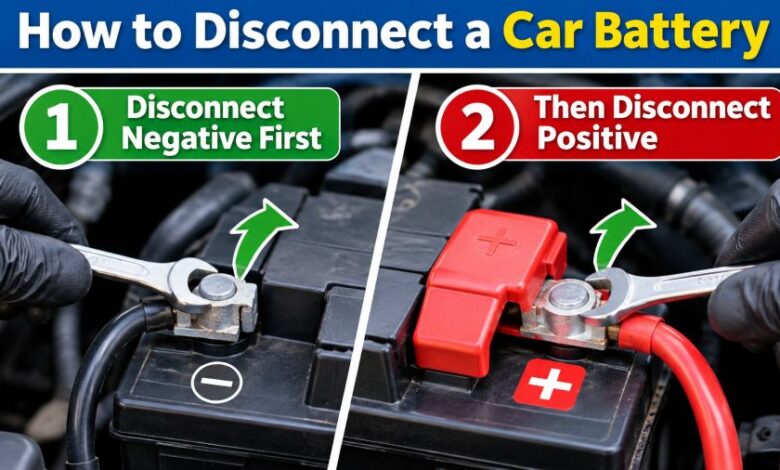
You should disconnect the negative terminal first. Then remove the positive terminal if needed. This is the standard method for most modern petrol and diesel cars.
Still, every car is different. Some have special electrical systems. Others need a short shutdown period before you touch the battery.
Here is how to handle the job safely.
Quick Facts About Disconnecting a Car Battery
| Detail | Information |
|---|---|
| Main task | Disconnecting a car battery |
| First terminal to remove | Negative (−) |
| Second terminal to remove | Positive (+) |
| First terminal to reconnect | Positive (+) |
| Last terminal to reconnect | Negative (−) |
| Common tools | Spanner or socket wrench |
| Common spanner sizes | 10mm or 13mm, depending on vehicle |
| Safety equipment | Gloves and safety glasses |
| Engine condition | Switched off |
| Battery location | Under bonnet, in boot, or elsewhere |
| Battery removal needed? | Only for certain jobs |
| DIY difficulty | Usually manageable on conventional cars |
These instructions mainly cover standard 12V negative-ground car batteries. Always check your vehicle handbook first.
Why Would You Disconnect a Car Battery?
There are several reasons.
Maybe your battery needs replacing. Maybe corrosion has built up around the terminals. Or perhaps your car will sit unused for a long time.
Battery disconnection can help with certain repairs. It may also reduce electrical drain during storage.
But do not disconnect it without a reason.
Modern cars depend on electronic systems. Removing battery power can reset some stored settings. A few vehicles also require special procedures afterward.
Tools Needed to Disconnect a Car Battery
You do not need many tools.
A few basic items usually work:
- Spanner or socket wrench
- Safety glasses
- Protective gloves
- Clean cloth
- Battery terminal cleaning brush, if needed
- Suitable terminal covers
Many cars use 10mm terminal-clamp nuts. Some need another size.
Check before starting.
Also, remove rings and watches. Metal jewellery can cause serious burns if it bridges electrical connections.
How to Disconnect a Car Battery Safely
Follow these instructions carefully. Do not rush the job.
1. Park Your Car Safely
Choose a dry, level parking spot.
Apply the parking brake. Switch off the engine completely. Turn off the lights, radio, and other accessories.
Remove the ignition key.
Some modern cars need extra shutdown time. Your handbook will explain this. Wait for the required period before disconnecting anything.
Never disconnect a battery with the engine running.
2. Find the Car Battery
Open the bonnet carefully.
Look for a rectangular battery. It normally has two electrical connections.
Many cars have batteries under the bonnet. Others keep them inside the boot or beneath a seat.
Cannot find yours?
Check the owner’s manual. It should explain the battery location and access instructions.
3. Identify the Positive and Negative Terminals
Look at both battery connections.
The positive terminal has a plus (+) symbol. It normally uses a red cable or protective cover.
The negative terminal has a minus (−) symbol. Its cable is usually black.
Do not trust colours alone.
Check the symbols printed on the battery. Correct identification matters more than cable colour.
4. Disconnect the Negative Terminal First
Start with the negative connection.
Use the correct spanner or socket. Gently loosen the terminal-clamp nut.
You normally do not need to remove the nut completely.
Lift the cable clamp away. Keep it clear of the battery post.
Do not pull on the cable itself.
If the clamp feels stuck, stop. Use a suitable terminal puller or ask a mechanic. Forcing it can damage the battery.
Keep the disconnected cable secured. It must not reconnect accidentally.
5. Disconnect the Positive Terminal
Now check the positive connection.
Remove its protective cover if fitted. Loosen the clamp using your wrench.
Lift the clamp off carefully.
Keep metal tools away from the opposite terminal. Never let a wrench bridge both battery posts.
Also, avoid contact between the positive terminal and the vehicle’s metal body.
Move the disconnected cable aside. Use suitable insulating covers where needed.
The battery is now disconnected.
6. Remove the Battery if Needed
You may not need this part.
If you only wanted electrical isolation, the battery can usually stay in place.
For replacement, check its retaining bracket.
Release the battery hold-down clamp or strap. Disconnect any required vent tube using the manufacturer’s instructions.
Then lift the battery carefully.
Car batteries are heavy. Keep the battery upright. Do not tip it or damage its casing.
Place it on a stable surface.
Why Must the Negative Terminal Come Off First?
There is a simple reason.
Most cars use a negative-ground electrical system. The negative cable connects to the car’s metal body and chassis.
Now imagine removing the positive terminal first.
Your metal wrench could touch the vehicle body while contacting the positive connection. That can create a dangerous short circuit.
The battery can deliver very high current.
Sparks and heat may follow. Wiring or other parts could suffer damage.
Removing the negative cable first breaks the normal connection between the battery and chassis.
That reduces the short-circuit risk.
Remember this simple rule:
Disconnect: Negative first, positive second.
Reconnect: Positive first, negative last.
Can You Disconnect Only the Negative Terminal?
Yes, in many situations.
For a conventional negative-ground car, removing the negative cable normally stops the vehicle drawing power through its usual electrical circuits.
This can help during long-term storage.
You do not always need to remove both terminals.
But battery replacement is different. Both cables must be disconnected before taking out the battery.
Also, some vehicles have multiple batteries or separate electrical supplies.
Check the handbook before assuming one disconnected cable is enough.
What Happens After Disconnecting a Car Battery?
Your car loses its normal battery power.
Some electronics may reset.
The exact changes depend on the vehicle.
| Vehicle feature | Possible change |
|---|---|
| Clock | Time may reset |
| Radio | Presets or security code may need restoring |
| Electric windows | Automatic operation may need resetting |
| Engine computer | Some learned settings may reset |
| Automatic transmission | Shift behaviour may need relearning |
| Stop-start system | May temporarily stop working |
| Battery management system | May need recalibration or registration |
| Alarm and locking | Powered features may become unavailable |
Older cars often have fewer electronic requirements. Newer cars may need more attention.
Always check the vehicle handbook.
Will Disconnecting the Battery Reset the ECU?
Sometimes, yes.
The engine control unit may lose certain learned settings. But disconnecting power does not erase everything.
It will not repair a faulty sensor. It also cannot fix damaged wiring.
Some fault information may remain stored.
Battery disconnection can reset emissions-readiness monitors, too. The car may need further driving before those tests become ready again.
Do not use battery disconnection as a substitute for proper fault diagnosis.
How to Reconnect a Car Battery
Reconnection uses the opposite order.
First, make sure the ignition is off. Check that the battery is sitting correctly.
If you removed it, secure its retaining bracket.
Then follow these instructions:
- Check both terminals for damage.
- Connect the positive (+) cable first.
- Tighten it to the manufacturer’s specification.
- Connect the negative (−) cable next.
- Tighten the negative clamp securely.
- Refit the protective covers.
- Check the electrical systems.
Neither clamp should move loosely.
Do not overtighten the connections.
Start the engine only after everything is secure. Check the dashboard for unusual warnings.
Some settings may need restoring.
Can You Disconnect a Car Battery for Storage?
Yes. Many owners do this.
A car parked for several weeks can slowly lose battery charge through its electrical systems.
Disconnecting the negative cable can reduce that drain.
But the battery still loses some charge naturally.
So disconnection does not guarantee a healthy battery months later.
A compatible smart battery maintainer may be a better choice during long storage periods.
There is another point.
Disconnecting the battery may disable the alarm, remote locking, and other powered features. Make sure you can access the vehicle again.
How Long Should a Car Battery Stay Disconnected?
There is no fixed time.
It depends on your purpose.
For battery replacement, reconnect after the work is complete.
For electrical repairs, follow the service instructions.
For storage, the battery may remain disconnected longer. Its charge still needs checking.
Some people disconnect batteries to reset warning lights. That is not a reliable repair method.
A warning light can return if the actual problem remains.
Can You Charge a Car Battery Without Disconnecting It?
Yes, in many cases.
Modern compatible battery chargers can often work while the battery remains connected.
But charger instructions matter.
Some vehicles also have special charging points. Their owners’ manuals explain where to connect the charger.
Use the correct charger for your battery type.
Do not assume every charger works with AGM, EFB, lithium, and conventional lead-acid batteries.
If unsure, ask a qualified technician.
Common Mistakes to Avoid
Small mistakes can become expensive.
Watch out for these problems:
- Removing the positive cable first
- Working while the engine runs
- Touching both terminals with metal tools
- Pulling cables instead of clamps
- Forgetting protective gloves and glasses
- Forcing a stuck battery clamp
- Reconnecting cables in the wrong order
- Leaving terminals loose
- Ignoring battery warning signs
- Forgetting vehicle-specific reset procedures
Also, never smoke near a battery.
Lead-acid batteries can produce flammable hydrogen gas. Sparks or flames can ignite it.
Do not attempt DIY removal if the battery is cracked, leaking, swollen, or frozen.
Get professional help instead.
Are Hybrid and Electric Car Batteries Different?
Yes. Their electrical systems can be different.
Many hybrid and electric vehicles have a low-voltage battery alongside a high-voltage traction battery.
Disconnecting the low-voltage battery does not make the high-voltage system safe to touch.
Some electric cars also use different low-voltage battery designs.
Never touch orange high-voltage cables.
Use the manufacturer’s exact service instructions. High-voltage battery work belongs with trained technicians.
When Should You Call a Mechanic?
Sometimes, professional help makes sense.
Call a mechanic if the battery is difficult to reach, damaged, leaking, or badly corroded.
Also, get help if you cannot identify the terminals.
Modern electrical systems can need diagnostic equipment. Some cars require battery registration after installing a replacement.
Trying random fixes can create more problems.
A short visit to a mechanic may save you a costly repair.
Final Thought
Learning how to disconnect a car battery is useful. It can make basic car maintenance easier.
But safety comes first.
Remove the negative terminal before the positive. Reconnect them in reverse order.
Keep your tools under control. Check the battery for damage. Follow your vehicle’s handbook.
And if something feels wrong, stop.
A careful job is always better than a rushed one.
Frequently Asked Questions
1. Which terminal should I disconnect first?
Disconnect the negative (−) terminal first. On standard negative-ground cars, this reduces the risk of accidentally shorting the battery through the vehicle body.
2. Can I disconnect a car battery myself?
Yes, many conventional cars allow basic DIY battery disconnection. Use proper tools and safety equipment. Check the handbook before starting.
3. Can I disconnect only the negative terminal?
Yes, often for storage or basic isolation. Secure the cable away from its post. Battery removal requires both terminals to be disconnected.
4. Will disconnecting the battery reset my car?
It may reset some electrical settings. The clock, radio, windows, and certain learned vehicle settings can be affected. The results depend on your car.
5. How long should I leave the battery disconnected?
There is no universal duration. Keep it disconnected only as long as your maintenance work or storage plan requires.
6. Can disconnecting a car battery damage it?
Correct disconnection normally does not damage a healthy battery. But incorrect handling, short circuits, or poor reconnection can damage electrical parts.
7. Can I disconnect a car battery without tools?
Some vehicles have special quick-release clamps. Most standard battery terminals need a suitable wrench or socket. Avoid improvised tools.
8. Does disconnecting a battery stop it going flat?
It reduces power drain from the car. But natural self-discharge continues. Long-term storage may still require maintenance charging.
9. Which terminal should I reconnect first?
Connect the positive (+) terminal first. Then reconnect the negative (−) terminal. Check that both connections are secure.
10. Do modern cars need a battery reset?
Some do. Certain vehicles need battery sensor resets, registration, or electronic feature initialization. Check the owner’s manual for your specific model.